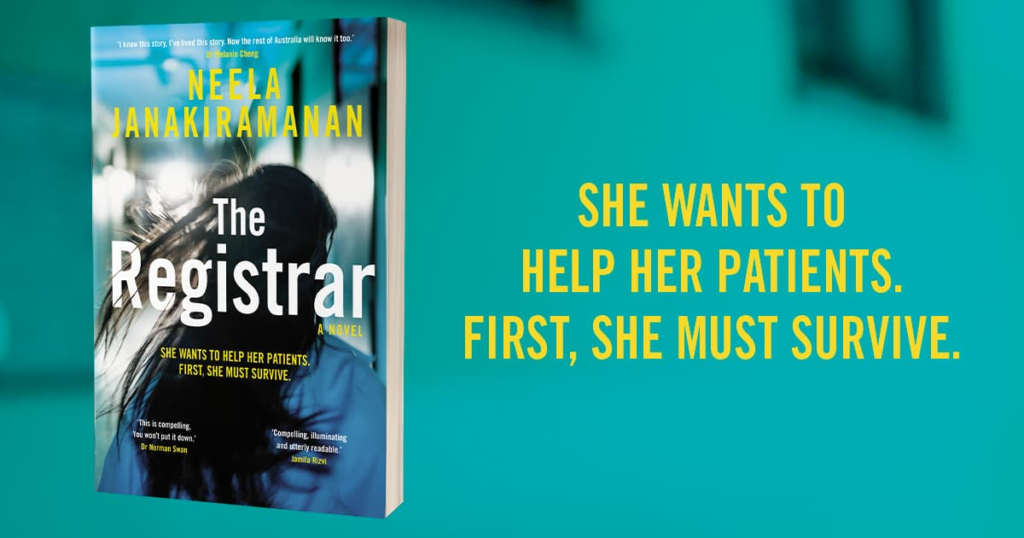
I was given The Registrar by Neela Janakiramanan for my birthday back in September 2022 and had really wanted to read it after Jamila Rizvi raved about it and after listening to Chat 10 Looks 3 (Annabel Crabb and Leigh Sales’ podcast) but I’ll admit that it took me a while to read it. Partly this was because of usual life/university/work demands but also because some of the reviews and testimonials described the book as very real and in the words of Norman Swan inside the cover “painfully real”. Having my own experience of working within our public health system in Australia, I just wasn’t sure I wanted to experience “real” and since my experience of burnout, I’ve mostly only read authors who I know I like and who write gentle sweet books.
But I’ve been on holidays, so felt like maybe I was ready to give The Register a go. And wow, what a read. Look honestly, I couldn’t put it down. I read it over 2 days and stayed up late to finish it as I needed to know what happened! It was well written, with heart and soul for patients and medical professionals. It was quite real and raw in places and the characters and experience of reading it were still sitting with me several days later. But I don’t want to make it sound like it was just a full on, exciting and yet awful read; it was also a really enjoyable novel and immensely relatable for probably any health professional, particularly anyone working in public hospitals.
[More detailed review below may include some minor spoilers (I’ve tried not to though!)]
The Registrar was an incredibly fascinating insight in to the medical and particularly surgical profession and you really went on a journey with the central character, Emma through her first year as a surgical registrar. The book describes her experiences and the impact that the punishing surgical training program has on her and her life as well describing the experiences of some of the other medical and surgical registrars at the hospital. Whilst the book is written as a novel, there was some great context given about the system and processes that medical students, residents and registrars go through to become specialist doctors. It describes the intensive training program, the culture and expectations around long hours with minimal breaks and rarely leaving on time, of having to prove yourself worthy constantly and live up to the demands and expectations of the senior medical staff whilst working hard to pass The Exam (final medical examination at the end of the registrar training program in order to become a specialist).
The Registrar was quite fast paced and progressed through the excruciating early days of starting in a new hospital and in to 6+ months (I got a little lost where we got up to when some major plot points went down towards the end; but it seemed as though she was close to finishing her year of training at this hospital). I totally related to Emma’s disorientation when she first started and the administration challenges; I think I worked for close to a year for a hospital at one stage before I got a swipe card access due to the unavailability of the relevant department at times outside of when I needed to be seeing patients. I’ve often felt like working in a hospital or public health system is like you’ve been landed in the middle of a cricket match without anyone telling you the rules. You might know how to bat or bowl but you don’t really understand the context in which to do that and no one seems to want to tell you explicitly and thus, you’re always on the back foot or always wrong, no matter what you do or don’t do. I really identified with Emma’s experience of this as well with some of her decisions throughout the novel.
Within The Registrar there were many characters to keep track of and remember how they were associated with Emma but they also added depth and different perspectives than Emma’s commentary which gave some balance. It was enjoyable to read about some of the complex aspects of different surgeries in some good detail to feel like you were watching an episode of “Grey’s Anatomy” but also understood a bit more about the body or the technical aspect of some of the surgeries; which was really interesting (to me at least!). I loved Emma’s patient centredness and determination to continue to recognise patients by their name, in a culture that often refers to clients by the type of surgery or the disease. I felt like Emma genuinely cared for her patients (and that the author did too) as well as taking pride in her surgical work and the outcomes she could achieve. I felt like the patient stories were really strongly written and whilst this is surely my own bias, I probably would have liked to have read some more about the patients and how they challenged Emma or how the hospital/systems etc impacted them. This would have kept humanity at the centre of the story and contrasted more with Emma’s increasing self absorption as she progresses throughout the training program. There were some nuances of Emma’s character that were a little irritating e.g. when she wasn’t really able to communicate meaningfully with some of her colleagues because she was being so self absorbed and struggling herself; but then this also gave her some very real flaws. Abrupt communication was poignantly noted elsewhere in the novel when Emma commented that she had come to realise that answering the phone without introduction or pleasantries was due to the person being “already beyond capacity” and knowing “they’re about to be asked to do something more” in an overloaded and overworked healthcare system. Emma had the self awareness to realise she had also started responding in this way and that her interactions with others were suffering due to her own overwhelm and the pressures upon her.
I did also find some of Emma’s dislike of individuals to be quite confusing; she acknowledged Albert’s teaching abilities but stated that he wasn’t her type of people when he seemed to be one of the only senior people (aside from David) that actually engaged positively with her without playing games or being chauvinistic (or a jerk). Nonetheless, I think that towards the end of the book, particularly after a serious incident with Emma’s brother (a general surgery registrar), that Emma does start to realise her judgements and priorities aren’t quite right.
My only other criticism of the book would be that after a serious incident at the hospital, Emma did return to work after a short break and 2 week holiday. Whilst she had reconnected with her husband during the holiday and she had some pause to reflect on what had happened; it was also clear that nothing had changed really at the hospital or within the role and it’s demands and expectations. Perhaps, expressing her true feelings to her family was cathartic and reconnecting with her supports was beneficial, it just seemed to me that someone who was so close to burn out and who then was involved in this quite serious incident, would really struggle with being able to meaningfully return to work and finish the first year of training. I know that doctors are really tough individuals but I just feel like the trauma response would have been too much and wasn’t quite realistic or indeed healthy to portray. Sadly a holiday is rarely the cure for burnout; it takes more than that. I did like that Emma found herself able to stand up to one of her Professors at the end and communicate truthfully to him about her experience. I guess I would have liked to see or hear more about how she coped with returning to her workplace; perhaps this reflects my own desire to know more about what helps people cope with these pressures or push on through and past burnout. In any case, I liked that the book had a good ending; not perfect with everything all tied up neatly as that would have been even more unrealistic. But it ended on a positive note and left me reflecting on some of the experiences and the journey we’d been on with Emma, her colleagues, patients and family.
Some further reflections from a health professional’s perspective particularly
There were some really witty and astute observations throughout The Registrar; some of the observations about the health and medical system were so on point, they made me gasp a little that someone had said this out loud. For example in relation to the annual rotations that happen, Emma comments
“I wonder if patients know how dangerous it is to be in hospital when this great annual medical migration happens- when whole teams change, and new doctors, who don’t know any of them and who don’t know where to find anything, suddenly take over their care”
I related to some other observations, like the character of Vikram, who left obstetrics to work in infectious diseases because it hurt when patients didn’t trust what medicine had to say or had other values they placed ahead of the best care; I felt that deeply. It has often felt this way to me, as a health professional, that we learn so much about best quality care and whilst the system causes us to make compromises all the time, we also work with people. People who are different and aren’t always an exact science, who wont always do what we recommend or what’s best for them. This is both what makes healthcare enjoyable, valuable and rewarding at times but also what makes it frustrating. There’s been many times I’ve questioned pursuing a career in health rather than engineering where maths and physics and how things work is a bit more black and white and just less “peopley”.
I also couldn’t help but chuckle at The Mount (the hospital Emma starts at) and their attempts at addressing burnout through the Workplace Transformation Committee which implements some plants in the residents room, healthy vending machines, fruit and an excruciating group meditation session but refuses to actually implement any meaningful changes that the staff actually want or feel would reduce burnout; like increased staffing or reduced hours or being able to turn your pager off for the aforementioned meditation session. Having been part of some of these discussions or at hospitals/health services where these things have been implemented, it all felt rather eerily like déjà vu. But also immensely frustrating and infuriating.
Part of what The Registrar shows is the challenges of the medical and surgical training program; something I cant really comment on as an OT (although surely there’s a better way for training and supporting registrars and residents?). I did relate to what is described as the “moral injury of being a bit crap” or at least feeling like we’re a bit crap within a “wordclass” hospital system. But significantly the other part of what The Registrar highlights is, I think, a more systemic issue around healthcare. The poor environment provided for health professionals to work in, in terms of offices and spaces; we’re made to feel like having a hot desk and a locker is more than enough and we’re being demanding asking for more. The challenges of moving patients through Emergency and the pressure this creates on everyone because there never seems to be enough beds available. The pressure to see more and more patients and to do more and more on top of the clinical load (Research! Committees! Conferences!) when there’s rarely any cover or backfill. The staff shortages. The long hours but no overtime (or capped flexi time); because you’re supposed to be grateful for the opportunity or having a permanent role. There’s this constancy of more; do more, be more, do it better, do more of it… Where nothing you ever do is enough and there’s never enough time; and yet you need to be enthusiastic about initiatives from management (Emma in The Registrar was told to be enthusiastic and smile more; I remember being told that I needed to be more positive- when the staffing levels for OT were getting dangerously low). And look, I know that there are many managers and executives that actually really do care and are probably just trying to do their best within the constraints they face. But I think that there just has to be a better way to do healthcare so that patients can get the best outcomes; it cannot be reasonable to continue to demand more and more from individuals within these massive systems and expect that we’re going to have the workforce we need to support the healthcare needs of our population. I don’t have all of the answers but I think we certainly need to actually listen to the voices of those on the ground, on the front line and truly consider what they have to say and make some meaningful changes.
I would rant further about this- but honestly, this post is ridiculously long as it is, so I’ll leave it there for now! Suffice to say, The Registrar was a ripper read and I look forward to hopefully reading further books from Neela Janakiramanan in the future.
The Registrar, Neela Janakiramanan, 2022, Allen and Unwin, ISBN: 978 176106 651 1, 368 pages