

One of the things that I love about my work and my job is the privilege of being able to connect with and work alongside other OTs and health professionals in both a clinical setting as well as in my supervision and mentoring work and University role where I work with other health professionals but notably I teach post grad students; so they’re already clinicians working in the health and disability sector, but doing more study and training. I also love that I still work with clients needing OT services and maintain that clinical focus in my private work. I often feel that it’s like I can be this bridge between the academic world and the clinical world; in a way I’m not fully immersed in or part of either. I also feel this gives me a really unique and broad perspective across issues affecting clinicians and clients and an understanding about each of these group’s needs. I do love this intersection of ideas and concepts but sometimes I feel a little bit overwhelmed with all of that. It feels like quite a responsibility at times to carry the weight of stories and feelings about the health sector; that there’s things that aren’t working for clinicians, and then experiences from clients that can be disheartening and I can see all of these perspectives all at once, all the time! I tend to take on the weight of the world at the best of times and sometimes in this unique space I find myself in, it can certainly feel like a complex tangle to unravel and to work out what to do with all this “stuff”.
Basically at my core, I want to help. I want to use what I think is a unique position, to help clinicians be better clinicians, to know more and do more and do better for their clients; to understand their clients more and to just do OT better. OTs talk about “occupation” as anything that “occupies” time not just an occupation in terms of a job; and I want to help OTs do their occupation of occupational therapy better! There is so much to know, so many skills to learn and so much that we can be doing in our role as OTs. But more than just loading up OTs with a burden and pressure to know more and build more skills, I want us to know more and do more, without burning out! And sometimes I really do wonder if that’s possible (tip: it is!).
Because I think that as a profession, one of the causes of burn out is when we might dilute some of the essence of what we know OT to be and how it works best. I know that there’s been times in the past when I have deviated from our core OT purpose and intentions and got caught up in systems and processes where I’ve been working and that have been imposed upon me. And I know that I’m not the only one who can struggle in systems like hospitals where there is limited resources and constant pressure to discharge. I hear colleagues struggling with NDIS and the complexity of reasonable necessary criteria or private practices and billing demands. It could be the discomfort of working in medical model of viewing a client as someone or something to be fixed. It might be working within a deficit based approach where we describe all the things someone cannot do, rather than focussing on a client’s strengths. We might feel uncomfortable or like we don’t fit in or our job might seem really difficult and stressful and unrewarding. And in time, I think we can get kind of ground down to think that’s normal even though we know that these are things that are not healthy and these models, systems and approaches are not core to us as OTs; to our values or our way of working.
I think this can lead us to unconsciously blame ourselves; perhaps as individuals and think that there’s something wrong with us, with how we are working or how we like to work. I know that for me, there have been times when I have felt like everyone else has it all worked out and seems fine with these systems or just accepts how they are, so how come I struggle with it? What’s wrong with me? Why doesn’t this feel manageable to me? Not generally being someone who is backwards in coming forwards, there’s certainly also been times when I’ve got myself very frustrated when I’ve tried to rebel against the system or tried (unsuccessfully) to change the system where I’ve worked. I’ve witnessed how the pressure imposed by these systems impacts our work, and even taints our work and we find ourselves changing how we do the occupation of OT because of the environment that we find ourself in. For example, in the rehabilitation space I think we sometimes try and medicalise our approach to fit in or because of pressure or expectations. I remember as a fresh young new graduate feeling like I’d disappointed and outraged my whole team when I refused to use stretch boards for client’s hands who’d had a stroke and introduced “controversial” activities like gardening. I researched endlessly and bought books and articles to try to back up what I knew was meaningful and important for my clients and why that should be a focus. I butted heads stubbornly with existing therapists and was probably insufferably self righteous about what I thought was the best approach. But deep inside, I worried constantly about whether I was actually right? I felt acutely aware that I didn’t talk the same way about “normal movement” or have a deep understanding of the stretch reflex (that seemed very important at the time!). I only knew that Joe* was an ex farmer who wanted to “use his hands again” and Elaine* loved craft and was the carer for her husband. I couldn’t understand why I was questioned and queried over trying to engage them in things that were more closely related to their goals.
As I’ve grown in experience, I’ve probably remained deeply stubborn about the power of occupation and of doing and how focussing on that is important and essential. I’ve probably grown in some confidence with the worth and value of that. But I’m not going to deny that I, like other OTs I’ve seen, have sometimes lost my focus on activities and tasks and doing and become reductionistic and deficit focussed on individual performance factors like fine motor skills and cognitive tasks. I think maybe we all do it sometimes… We use cups and cones in upper limb groups and get bored of trying to come up with something exciting to do with blocks or paper cups. We might do functional tasks like breakfast group in a hospital but not in a way that is meaningful for a client as it might become rote and standard and just something we “do” as OTs- another task to tick off, another client seen for the day, another statistic to justify our time. We might initially fire up in a case conference about why it’s important to address cognition in rehabilitation for a safe discharge and get frustrated at not being heard. But over time, we might become quieter or less convinced, particularly if we feel like we’re the only person in the room who believes that. We might agree to run therapy sessions on a tight 30 minute schedule even though we know that’s not actually enough time to build the relationship necessary to address their challenges. We might cut back on reviews and reassessments because others tell us it’s not essential. We might agree to spend less time on writing reports even though we know that communicating about a client in writing to do them justice and explain our reasoning, might take longer than the budgeted time we’re supposed to use. We might try to fit in and go along with what others are doing or what they think we should be doing and expect us to be doing and we may think that this is what OT is in practice.
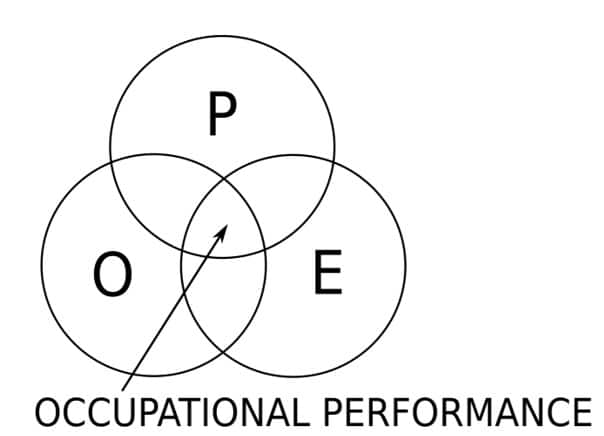
And then I think, using our good ol’ PEO model, that this then affects us as a person. It can affect who we are and how we show up in OT and how we do our occupation and deliver our OT services i.e. our occupational performance as occupational therapists! As I said, I think it can lead to exhaustion and burnout but also to mental health challenges as well as feeling dissatisfied and disappointed in the profession of OT. For me, it’s meant that something I so passionately believe in sometimes feels like it never quite lives up to it’s promise. There’s a mismatch between this wonderful way of viewing people and the approach that we learn at university about how we can work with people and then how in reality we end up delivering our services as OTs.
And because I’m interested in burnout (having experienced this myself) and because I work with OTs and at a university where I (in part) get paid to think and plan and teach OTs, then I do end up doing a lot of thinking and reflecting about OT and our role and our value and how we can know and be sure of that. How we can be confident and not lose our focus or our uniqueness or our passion. And I’m not the only one because there are a number of OTs doing work in this space and thinking about and reflecting about OT. Wonderful passionate people like Brad Williams and The Becoming Collective and Rhiannon Crispe and her Finding Me in OT video and OT Lifestyle Movement group.
But, controversially, I wonder too whether all this reflection, is always a good thing?
You see, OT has always had a bit of an identity issue, in my opinion. We have persistently been a bit obsessed with defining and explaining “occupation” and wanting people knowing what we do; often defining ourselves by what is different about OT compared to other disciplines (e.g in the neuro rehab space we might have said “it’s kind of like a combo of physio and psychology” or “like physio but only really upper limbs.. Oh and the things you need to do with your hands” ). We’d get offended about people thinking we were the same as occupational health and safety or saying we were basket weavers (as if that was a bad thing; because that’s usually how it was framed) or diversional therapists. We might pursue further education or research as a way of building up our legitimacy or demonstrating our worth (I have definitely been guilty of this!). We might explore occupational science as a way to sometimes, “sciencefy” our understanding of people and our role [this isn’t having a go at occupational science by the way: only when we feel pressured to go down this path to justify our existence]. I sometimes think we spend a LOT of time and energy on defining ourselves and explaining ourselves and justifying ourselves. And it’s tiring! As my beautiful friend, Bec says “butting up against a system is exhausting… and means that means we’re constantly in an advocacy role on top of our clinical responsibilities”.

I ponder if all of this questioning, advocacy and explanation about who we are as OTs means that we turn our focus inwards. Not just to ourselves as individuals but inwards as a profession. We feel like we have to redefine what we do, rediscover OT and work harder to better communicate with others. That we, as a profession, have to work harder on ourselves and in defining and explaining ourselves and our worth. I worry if I have sometimes become, almost indulgently, self absorbed and spent a bit too much time navel gazing, thinking and worrying about OT and our profession and less time in actually doing the job of OT?
And what if that’s not that helpful all the time?
What if our discomfort with systems, models and processes is actually a good thing? A clue towards a better way of delivering healthcare services, not just for our profession, but more generally. Because we’re not the only profession that actually struggles with some of these systems and models. My book review of The Registrar by Dr Neela Janakiramanan highlighted the pressure that our surgical colleagues experience in the hospital system, which felt distinctly and eerily familiar. My upcoming book review of Experiences of Health Workers in the COVID-19 Pandemic (Bismark, Willis, Lewis & Smallwood, 2022), whilst discussing the pandemic, raised broader health system issues which were experienced by a significant range of health professionals across different health settings. I suspect that we are not alone in our struggles of the pressures and challenges of modern healthcare, even if we perceive other professions as fitting in better or struggling less than we do to be heard and valued.
I wonder if we, as individuals and as a profession, could look beyond ourselves and consider with a curious mindset, what the environmental challenges are with where we are working as therapists? If we could acknowledge those pressures and challenges and identify what it is that we’re struggling with externally? That perhaps, a bit like our more modern understanding of disability and the social model of disability or neurodivergence, we might see that the cause of some of our challenges is in health care systems, in policies, in society and their perception, not within us?
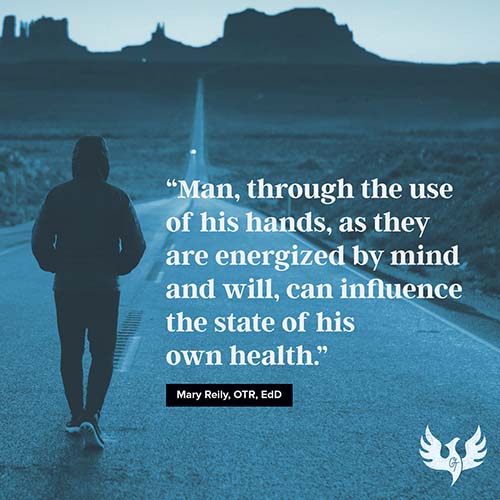
https://otpotential.com/blog/occupational-therapy-quotes
Because, I think, again as my friend Bec says, OT is “counter-cultural” to the well established and long standing medical model and systems. In fact, OT was deliberately put forward as a separate entity to other disciplines to be that way. As a profession, it was deliberately developed to be different, distinct and to offer something that only a few individuals within other disciplines were doing (remember our history from social work, medicine, psychiatry amongst others). What if that’s actually our superpower? What if not belonging isn’t something to be feared, but rather something to be proud of and to celebrate? What if feeling uncomfortable in reductionist systems, means we’re doing OT right?
I think that we need to remember and understand that OT does view things differently from traditional and long established models; with a view of the whole person, a focus on doing, an acknowledgement of the environment and contextual factors and a problem solving approach that considers all of this within our role. And sometimes, when I see clients clinically, I’m reminded that they see us in all our value and worth so often. They so often see us, they know who we are and what we do and what they need from us. They know that we are the ones to help with equipment to do something they want to do but cant physically manage. They know we’re the problem solvers. They know, I think, that we’re different; we listen, we “get it”, we come from a different perspective, that we help with “doing” (and yes, “being” and “becoming” too). They know it’s the things that they want to do that are central to our role and they so often want us and need us, even when they don’t always know how to define what we do.
Perhaps then, our difference, is something that we can accept about ourselves and even celebrate about ourselves. That our role is to stand out, to be a point of difference and to offer a unique perspective. I believe that we could potentially become a safe space for other colleagues who may also feel different and want to work differently. I am confident that we could even potentially change some of the systems and processes and models we find ourselves working within (I know there are OTs out there doing this hard hard work!). I think we could start to be OT “affirming” and not so hard on ourselves; we could have compassion for ourselves and the difficulties of being different in a system we didn’t build and were never intended to “fit” within. We could believe that we have a role and value in our difference and be confident in that. I deeply believe that we could be OT’s for ourselves and focus on supporting ourselves in doing, being and belonging within our profession and beyond; that we can be proud of ourselves in our differentness and give ourselves permission to love our profession again, without embarrassment or shame.

If you feel you need support in your role to remain true to your values of OT or need a burst of encouragement and confidence, feel free to reach out. I suspect that knowing there’s others out there that struggle too at times, is part of the key to feeling OK about being different, but we also need to take care of ourselves and each other as we navigate a challenging healthcare sector. I’m all here for that, if that’s what you need!
* Names changed (mostly I cant remember their actual names, unfortunately).
With gratitude and thanks to Bec Secombe who read an earlier draft of this and provided valuable feedback and prompted further thoughts and refining of my message. Check Bec out here https://www.instagram.com/the_nd_ot/


